




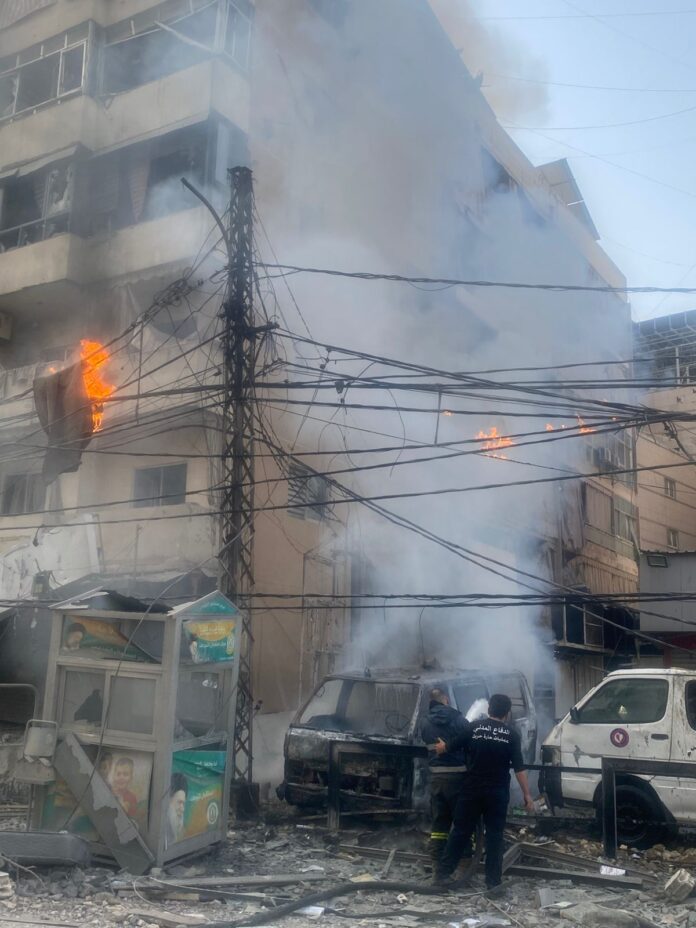
Amid the devastating war unfolding in Lebanon and in light of statements and warnings suggesting the possible targeting of ambulances and medical facilities, Amel Association International calls for urgent Lebanese and international action to confront these threats and to put an end to violations that may affect the health sector and humanitarian personnel working on the ground.
Ambulances, health centers, and medical and humanitarian personnel are fully protected under international humanitarian law, particularly the Geneva Conventions and their Additional Protocols, which clearly stipulate the protection of medical personnel and facilities during armed conflicts. Targeting them under any pretext constitutes a grave violation of international law and may amount to a war crime warranting international accountability.
Amel warns that current developments raise serious concerns about a repetition of scenarios witnessed in Gaza, as well as during previous wars in Lebanon, where health facilities and humanitarian workers were directly targeted. The continuation of such practices, in the absence of serious international accountability, has encouraged Israel to persist in violating international and humanitarian law, opening the door to repeated attacks against civilians and those working to save their lives.
Any targeting of ambulances, paramedics, medical centers, or humanitarian workers constitutes a direct assault on the right to life and on the fundamental principles of humanity, and cannot be justified under any military pretext.
Humanitarian and health workers in Lebanon have already paid a heavy price during this war. A significant number of medical and humanitarian personnel have been killed while carrying out their duties in rescuing the wounded and assisting civilians, and several health centers and hospitals have sustained damage as a result of bombardment. Amel extends its condolences to the families of the victims among paramedics and health and humanitarian workers who lost their lives while fulfilling their noble mission.
The organization also pays tribute to the heroes on the front lines, including the Lebanese Civil Defense, the Lebanese Red Cross, health and relief organizations, humanitarian NGOs, and all paramedics and healthcare workers who continue to carry out their duties under the most difficult conditions, risking their lives to save others and serve their communities.
Amel further calls for the establishment of an independent national mechanism to monitor and document any attacks against medical and humanitarian personnel in Lebanon, in cooperation with human rights and humanitarian organizations, with the aim of reporting these violations to the United Nations and competent international judicial bodies. It also calls for the formation of an emergency humanitarian coordination cell bringing together the Ministry of Public Health, the Lebanese Red Cross, Civil Defense, and humanitarian organizations, to ensure the protection of health facilities, ambulance routes, and safe operating conditions.
The organization urges the United Nations, the Security Council, the World Health Organization, and the International Committee of the Red Cross to take urgent measures to ensure the protection of the health sector in Lebanon and to prevent any targeting of humanitarian personnel.
Amel Association International reaffirms that protecting medical and humanitarian workers is not a political choice, but a legal and ethical international obligation that must be respected under all circumstances. It holds any party that may target them fully responsible for any crimes committed against them. Protecting those who save lives is not only a humanitarian demand but also a legal and moral duty incumbent upon the international community. When ambulances are targeted and paramedics are killed while performing their duties, humanity as a whole is under attack. In this difficult moment for Lebanon, the organization reaffirms that it will remain, as always, alongside the people and on the ground, defending human dignity and the right to life, care, and survival.

 Creative Commons Attribution 4.0 International license


