




When the Sanctity of a Hospital Is Violated, Humanitarian Values Lose All Meaning and Legitimacy
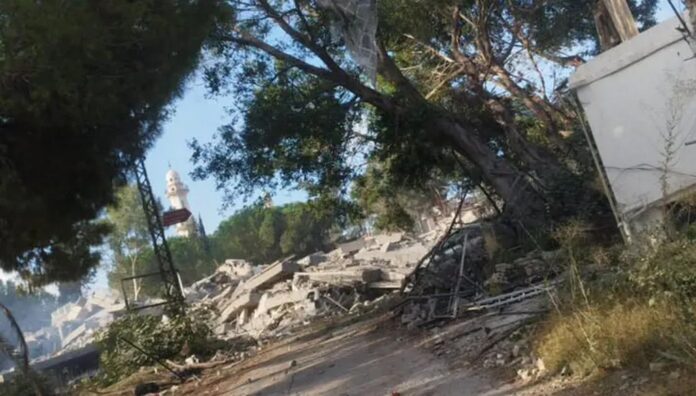
Amel Association International considers the destruction of Ghandour Hospital in Nabatieh al-Fawqa by Israeli airstrikes to be yet another episode in the continuing and deliberate Israeli attacks targeting civilians, healthcare facilities, and essential services in Lebanon. These attacks form part of a broader campaign aimed at intimidation, displacement, and the erosion of people’s ability to remain resilient and steadfast, particularly in southern Lebanon.
The Ministry of Public Health announced that the hospital had been completely destroyed. Since 2 March 2026, 17 hospitals have reportedly sustained damage, while three hospitals in southern Lebanon have been forced out of service as a result of the attacks.
The statement reads:
“Targeting a hospital is not merely the destruction of a building. It is an attack on the human right to life and on the place to which the wounded turn for survival, patients for treatment, and mothers for the safety of their children. When hospitals themselves become targets of war, the question extends beyond Lebanon and transcends all borders: What space remains for humanity when even the places intended to protect human life are no longer safe?
Healthcare and humanitarian workers, from Gaza to Lebanon, have paid a devastating price in these wars. In Lebanon alone, Ministry of Public Health data recorded 179 attacks on healthcare facilities and 135 attacks on healthcare workers since 2 March 2026. A total of 410 healthcare workers have been killed and 263 others injured. These are not mere statistics. Behind every number is a doctor, nurse, paramedic, or healthcare worker who chose to remain beside people during their most dangerous moments.”
The statement continues:
“What is happening in Lebanon cannot be separated from the broader regional context or from the repeated targeting of the healthcare and humanitarian system in Gaza, where healthcare and humanitarian workers have paid an unprecedented price while carrying out their duties toward civilians. Has the world not already lost enough doctors, nurses, paramedics, and humanitarian workers? How many more hospitals must be destroyed before defending the inviolability of healthcare facilities becomes an unwavering international position that admits no compromise?
Amel Association International believes that the danger today is no longer limited to the scale of the destruction and the number of victims, grave as they are. It now extends to undermining the very rules established by humanity to limit the brutality of war. International humanitarian law was not created to be invoked selectively. Protecting medical facilities and healthcare workers is neither a political position nor a privilege that a military power may grant or withdraw; it is a fundamental principle governing the protection of civilians during armed conflict.”
The statement further warns:
“Amel Association International cautions that continued impunity and international silence in the face of attacks against civilian and healthcare facilities threaten to turn the exception into the rule. A world that accepts the violation of a hospital here or a school there may awaken tomorrow to a reality in which no hospital, school, ambulance, or humanitarian worker enjoys genuine protection in any conflict, anywhere. What is being undermined today in Gaza and Lebanon is not only the security of their peoples, but also the credibility of an entire international system that was supposedly established to protect human beings and prevent force from becoming the only law.”
The Association stresses that protecting international law is not the responsibility of victims; it is the responsibility of the international community as a whole. Amel Association International therefore calls upon the United Nations, influential states, international organizations, and human rights, medical, and humanitarian bodies to move beyond statements of concern and condemnation and take serious and immediate action to enforce respect for international humanitarian law, protect civilians, healthcare facilities, and their personnel, and ensure that violations are investigated and those responsible held accountable.
The Association also calls for a unified Lebanese national position in defence of the healthcare and humanitarian sectors, beyond political divisions. The protection of hospitals, healthcare centres, ambulances, and healthcare and humanitarian workers must be placed at the forefront of Lebanon’s national and diplomatic priorities. The right of the Lebanese people to treatment, life, and safety is not the concern of one group or region; it is a matter concerning the entire nation.
Amel Association International, which has made the right to health and the protection of human dignity central pillars of its mission since its establishment in 1979, affirms that it will continue to fulfil its healthcare and humanitarian responsibilities. It will not retreat from standing alongside people in southern Lebanon and throughout the country, regardless of how difficult the circumstances become.
The Association also expresses its full solidarity with all healthcare and humanitarian workers and with the medical institutions that continue to fulfil their mission despite the dangers they face. It pays tribute to those who lost their lives while performing their humanitarian duty.
The statement concludes:
“Silence does not protect the law, and condemnation without accountability does not stop attacks; it emboldens the aggressor and undermines international law. What Lebanon and Gaza need today is not more expressions of regret, but international resolve capable of restoring meaning to the law and protection to human beings. When the sanctity of a hospital is violated, it is not merely a wall that falls; the foundations of a civilized and humane world fall with it, and the humanitarian values we defend lose all meaning and legitimacy.”

 Creative Commons Attribution 4.0 International license


