



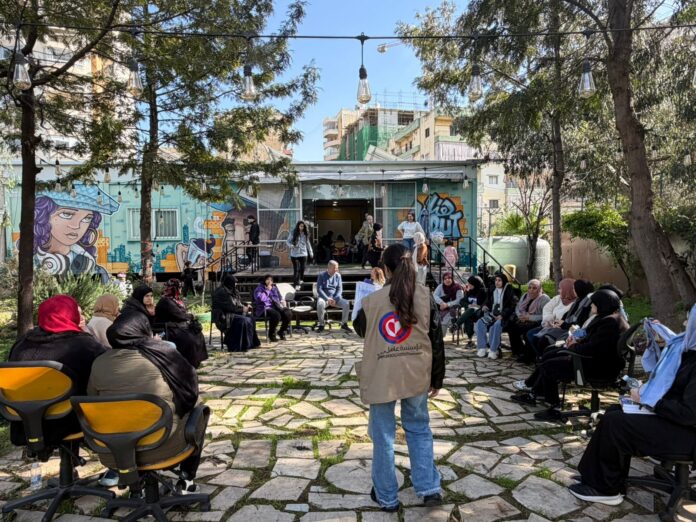
Throughout 2025, Lebanon continued to face a highly complex humanitarian landscape marked by displacement, socioeconomic hurdles, and persistent insecurity. In the face of these challenges, Amel Association International’s Protection Sector maintained a dual approach, pairing critical emergency responses with sustained regular programming. This review highlights how our team worked to ensure no one was left behind, combining technical specialization with deep community integration to protect the dignity of all.
2025 Protection in Numbers
By leveraging our strong grassroots presence and the unwavering dedication of our teams, Amel’s Protection Sector reached an estimated 217,976 individuals across five core pillars in 2025.
| Programmatic Pillar | Core Focus | Individuals Reached |
| Gender-Based Violence (GBV) |
Multisectoral response, case management, and safe spaces. |
195,518
|
| Child Protection |
Social and behavioral change, psychosocial support, and case management. |
8,100
|
| Support to Migrant Workers |
Individual support, legal aid, skills-building, and systemic advocacy. |
6,858
|
| Older Persons |
Tailored assistance, healthy aging promotion, and specialized care. |
4,400
|
| Community-Based Protection |
Meaningful community engagement and active participation. |
3,100
|
Deep Dive: Our Impact Across Pillars
1. Gender-Based Violence (GBV) Response
Addressing the safety and rights of GBV survivors and individuals at risk remained a fundamental priority.
-
Awareness & Action: We reached 112,492 individuals through targeted awareness-raising sessions and distributed essential non-food item (NFI) kits to 37,902 individuals.
-
Access to Services: Our referral networks linked 13,380 individuals to specialized multi-sectoral care, including medical, legal, and livelihood resources.
-
Mental Health & Legal Aid: We facilitated structured group psychosocial support (PSS) for 6,315 individuals, provided specialized psychotherapy for 2,364 people, and delivered legal aid counseling to 495 individuals.
-
Safe & Healing Spaces: Over 6,288 individuals accessed dedicated safe spaces within our centers, and 5,132 people participated in socio-recreational activities designed to support emotional recovery.
“When I first walked into the safe space I couldn’t even look up. Six months later I am running the peer support group. The case worker listened without hurry, and that is what made me believe I could heal.”
— D., a participant in safe space activities
2. Child Protection
Focusing on sustainable behavioral change, our child protection initiatives aimed to build safe and supportive environments for children.
-
Community Dialogue: We engaged over 8,100 individuals in dialogue challenging harmful norms, including early marriage and child labor, and saw 3,066 caregivers and community members participate in awareness sessions.
-
Psychosocial & Individual Care: Mental health and psychosocial support reached 1,617 individuals (with 981 in structured groups), while 341 children received professional case management.
-
Referrals & Future Skills: We successfully referred 250 children to specialized services and enrolled 1,038 individuals in skills-building and vocational training.
“We stopped counting only caseloads and started counting referrals that close the loop. Following up with every child until they receive the service they were referred to is what really changed outcomes on my caseload.”
— L. Ajrouch, Child Protection Program Coordinator
3. Support to Migrant Workers
Amel worked persistently to mitigate the harmful impacts of the Kafala (sponsorship) system and address the unique vulnerabilities of migrant domestic workers.
-
Emergency Assistance: Essential NFIs, bedding, and dignity kits were distributed to 3,666 migrant workers.
-
Individual Case Care: A total of 1,542 individuals benefited from psychosocial support, and 342 received tailored case management.
-
Rights, Education, & Vocational Training: We supported 330 workers through rights awareness sessions, provided legal aid counseling to 85 individuals, and trained 612 people in vocational programs.
-
Advocacy & Systemic Reform: Amel trained 20 judges on identifying human trafficking victims, supported six migrant-led initiatives, and ran workshops with migrant leaders to co-develop anti-Kafala advocacy campaigns.
4. Older Persons
We prioritized age-specific vulnerabilities to ensure older adults in Lebanon are visible, active, and respected.
-
Information & Awareness: Over 2,764 older individuals learned about service pathways and healthy aging strategies.
-
Direct Care: We provided targeted case management to 444 individuals and specialized psychotherapy to 317 others.
-
Social Inclusion: To combat isolation, 410 individuals joined wellbeing activities, and 297 participated in community-based protection events.
5. Community-Based Protection
Empowering local communities to guide their own protection responses lies at the heart of our work.
-
Local Leadership: A total of 1,490 community members actively contributed to designing and overseeing projects in 2025.
-
Accountability: We achieved a 94% satisfaction rate among participants who felt they had safe, confidential access to feedback and complaint channels.
-
Livelihoods: Out of 263 individuals who completed vocational training, 31% reported that their new skills directly improved their income-generating opportunities.
2025 Milestone Events & Youth Initiatives
Our impact in 2025 was further defined by significant advocacy events and local community-led initiatives:
-
Ageing Unit Launch (May 27, 2025): Amel officially launched its specialized Ageing Unit, creating a hub for research, capacity building, and age-inclusive policy advocacy.
-
Protecting Street-Connected Children: In June, we organized the “Stronger Together” workshop in Beirut to coordinate child protection referral mechanisms. In July, the French Ambassador hosted the launch of “At the Crossroads of Tomorrow,” a comic book illustrated by a Lebanese artist highlighting the daily realities of street-connected children.
-
Women’s Economic Empowerment (WEE) Assessment: Run in September in partnership with Plan International under the She Leads project, this initiative analyzed workplace gender equality and built a roadmap for inclusive human resources policies.
-
The “She Leads” Young Activists Booklet: Published in October, this booklet compiled 80 inspirational stories of young women leading advocacy campaigns across South Lebanon.
-
Grassroots Community Campaigns: Youth-led initiatives took off locally:
-
In Ersal, community members rehabilitated a public garden and playground for children.
-
In Hay El Selloum, committees installed speed bumps and safety mirrors near local schools.
-
In Bezourieh, young women successfully advocated with religious and legal leaders to incorporate protective clauses into marriage contracts.
-
In Saida, school outreach campaigns helped establish sexual and reproductive health education in two local schools.
-
In Tyre, collaborative youth efforts led to the creation of a municipal youth committee dedicated to GBV prevention.
-
In Hasbaya, students successfully campaigned for the appointment of trained GBV school focal points.
-
In Shwaya, young women secured a dedicated training space in the municipality and signed educational and employment pledges with local MPs.
-
Looking Ahead: Our Goals for 2026
As we step further into 2026, Amel’s Protection Sector is focused on pushing boundaries even further:
-
Holistic Sector Integration: We are integrating protection principles seamlessly across all other sectors, including health, education, shelter, and livelihoods.
-
Expanding Specialized Reach: We are scale-targeting services for the most marginalized groups—including older people, persons with disabilities, and female-headed households.
-
Strengthening Partnerships: We are sharing our technical protection frameworks, tools, and expertise with local actors and civil society organizations to build a stronger, more resilient humanitarian network across Lebanon.
“2025 represented a significant milestone for the Protection Sector. Beyond expanding our reach, this year allowed us to strengthen the quality, depth, and specialization of our interventions… The progress achieved throughout 2025 provides a strong foundation for the next phase of our work, positioning us to further strengthen integrated, accessible, and high-quality protection services throughout 2026.”
— D. Khalil, Protection Program Coordinator

 Creative Commons Attribution 4.0 International license

