





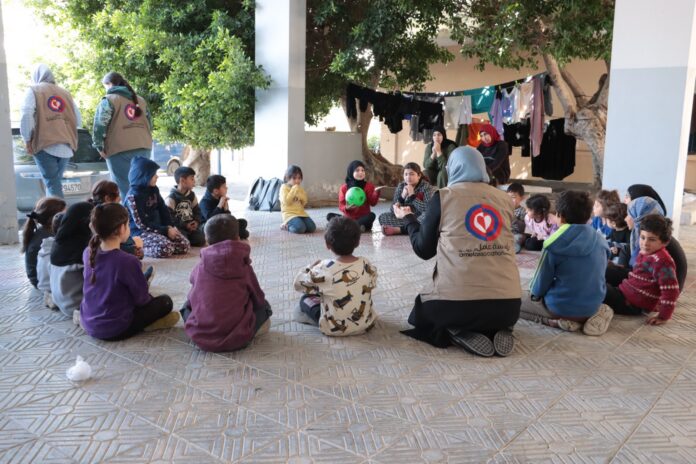
Amel International Association stressed that continuing to address the shelter and displacement crisis through temporary solutions is no longer acceptable amid the escalating humanitarian and social deterioration. The organization called on the Ministry of Social Affairs to move toward practical measures by establishing new shelters that are safe, dignified, and compliant with minimum humanitarian standards, while preserving the dignity of affected and displaced families.
The organization considered that the continued reliance on schools and educational institutions as emergency shelters is incompatible with a comprehensive vision for managing long-term social and humanitarian crises. It places thousands of students and families before an uncertain future in the coming academic year, only a few months away, at a time when Lebanon must protect children’s and youth’s right to education as a fundamental right that cannot be postponed or negotiated.
Amel Association noted that many schools and educational centers have effectively ceased performing their natural educational role for months due to their use as temporary shelters, in the absence of adequate social infrastructure and emergency-response facilities. This situation threatens serious repercussions for the educational process and for the psychological and social stability of children, teachers, and families alike.
The organization emphasized that humanitarian crises cannot be managed through patchwork solutions or temporary responses, but rather through clear public policies based on advance planning, respect for human rights, and adherence to international standards related to the protection of displaced persons and vulnerable groups. These include the rights to adequate housing, privacy, health, social protection, and education.
Amel further stressed that current shelters, in many cases, fail to meet the minimum conditions for dignified living, whether due to overcrowding, lack of privacy, or insufficient basic services. This exacerbates the suffering of families and leads to serious psychological and social consequences, particularly for women, children, older persons, and persons with disabilities.
The organization stated that international standards on the protection of internally displaced persons affirm that protection problems do not arise solely as a result of displacement itself, but continue and worsen throughout displacement and during the search for durable solutions. This requires states to adopt a comprehensive approach that goes beyond limited emergency responses.
Amel also warned that the absence of a clear vision for managing internal displacement and shelter policies increases social tensions and weakens the resilience of local communities, especially amid difficult economic conditions and declining basic services. The organization stressed that protecting displaced persons is inseparable from protecting host communities and safeguarding the rights to education, healthcare, and a dignified life.
In this context, Amel International Association called on the Ministry of Social Affairs to develop a clear national emergency plan that includes:
- Establishing alternative shelters equipped according to humanitarian standards.
- Providing healthcare, psychosocial, and social support services within these shelters.
- Adopting a participatory approach involving municipalities, civil society, and humanitarian organizations.
- Developing long-term social protection and emergency housing policies.
The organization also called on the Ministry of Education to immediately initiate a plan to rehabilitate schools and restore their normal educational role before the beginning of the next academic year, while establishing mechanisms to prevent educational institutions from becoming a permanent substitute for the absence of official shelter policies.
Furthermore, Amel urged the Lebanese government to adopt a clear national policy for managing internal displacement based on human rights principles and international humanitarian standards. The policy should rely on coordination among ministries, municipalities, humanitarian organizations, and civil society, while ensuring transparent mechanisms for monitoring, follow-up, and accountability.
Amel International Association concluded by emphasizing that human dignity cannot remain hostage to temporary solutions or political and media rhetoric, and that protecting people begins with ensuring adequate shelter, education, and social protection, responsibilities that must neither be postponed nor treated merely as part of day-to-day crisis management.

 Creative Commons Attribution 4.0 International license


