



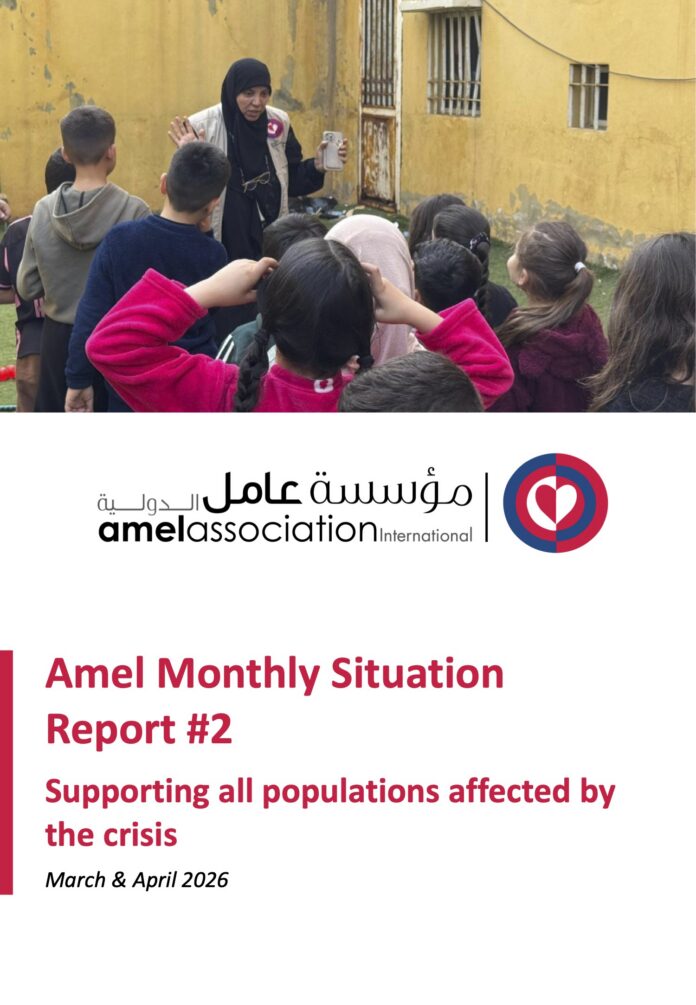
Amel Association International announced that Lebanon’s humanitarian crisis continues to deteriorate at an alarming pace, as widespread displacement, damaged infrastructure, and growing shortages of essential services place hundreds of thousands of families in increasingly precarious conditions. In response, Amel intensified its emergency operations during March and April 2026 to provide life-saving assistance, healthcare, protection, and education support to the most vulnerable populations across the country.
According to Amel’s Monthly Situation Report #2 for 2026, more than 1.2 million people have been displaced, while large numbers of families continue to live in overcrowded shelters, informal arrangements, and unsafe conditions. The report also highlights serious violations affecting civilians, healthcare workers, and journalists, as well as extensive destruction of infrastructure and the closure of hospitals and primary healthcare centres in conflict-affected areas.
Amel reported reaching 101,581 people across 187 sites through its nationwide network of centres, mobile units, and emergency teams. The response included health services, protection activities, educational support, and humanitarian relief distributions.
As part of its health response, Amel delivered more than 51,000 health services, including nearly 31,000 primary healthcare consultations, through 19 operational health centres and 14 mobile medical units serving displaced and underserved communities. Services included reproductive healthcare, medication dispensing, mental health and psychosocial support, vaccinations, and referrals to specialized care.
In the protection sector, the organization implemented integrated interventions addressing psychosocial support, gender-based violence prevention and response, child protection, awareness raising, and case management. More than 20,000 individuals benefited from protection-related activities, the majority of whom were women and children.
Amel also expanded targeted support for vulnerable groups, including older persons, persons with disabilities, pregnant and lactating women, and migrants. The organization distributed assistive devices, hygiene materials, diapers, food parcels, mattresses, and other essential relief items to displaced households and communities in need.
The report emphasizes that nearly 90% of displaced people remain outside collective shelters, making outreach and assistance significantly more difficult. Amel warned of growing shortages in medicines, hygiene supplies, educational materials, and emergency resources, while several of its centres and vehicles sustained damage during the escalation.
Amel Association International called on the international community, donors, and humanitarian partners to urgently increase flexible humanitarian funding in order to sustain emergency operations, expand access to healthcare and protection services, and preserve the dignity of affected populations, particularly in southern Lebanon and hard-to-reach areas.
The report reflects Amel’s continued commitment to providing a comprehensive, inclusive, and multi-sectoral humanitarian response to all populations affected by the crisis in Lebanon.

 Creative Commons Attribution 4.0 International license

