



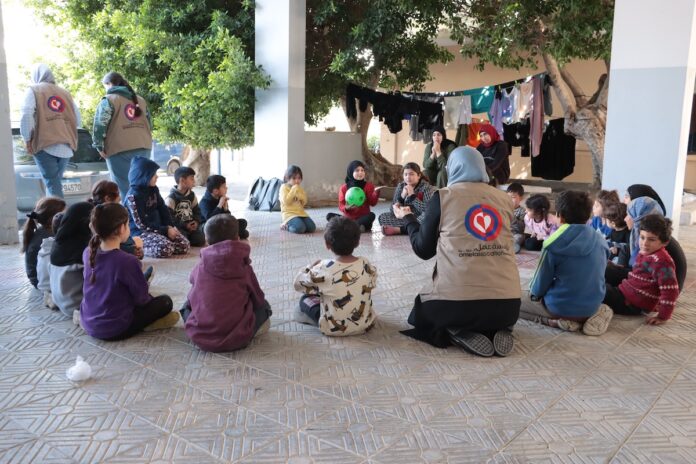
Amid the ongoing escalation of Israeli aggression against Lebanon since 3 March 2026, Israeli attacks have resulted in the killing of at least 1,029 people, including 118 children and 40 healthcare workers, as of 22 March. Displacement dynamics remain deeply concerning, with the number of displaced persons exceeding 1.2 million, including more than 133,678 currently residing in 645 collective shelters. The total number of displaced families in these shelters has reached 34,102 as of the same date. These facilities are operating beyond their capacity, facing severe shortages in electricity, water, sanitation, and privacy, thereby increasing protection risks, particularly for the most vulnerable groups.
The suffering of hundreds of thousands of internally displaced persons, who have been forced to flee their homes due to bombardment, violence, and insecurity, continues to worsen. In this context, Amel Association International stresses that the protection of internally displaced persons is no longer a temporary humanitarian concern, but has become a true test of the commitment of the state and society to the principles of human rights, justice, and human dignity.
At the same time, Amel Association International commends the widespread expressions of community solidarity witnessed across Lebanon, where local communities, individuals, and grassroots initiatives have stepped forward to host and support displaced persons despite difficult conditions. These initiatives represent a living example of the values of mutual aid and solidarity that characterize Lebanese society, and reaffirm that the humanitarian response is not limited to institutions, but extends to society as a whole.
La souffrance de centaines de milliers de personnes déplacées à l’intérieur du pays, contraintes de fuir leurs foyers en raison des bombardements, de la violence et de l’insécurité, ne cesse de s’aggraver. Dans ce contexte, l’Association Amel Internationale souligne que la protection des personnes déplacées internes n’est plus une simple question humanitaire conjoncturelle, mais constitue désormais un véritable test de l’engagement de l’État et de la société envers les principes des droits humains, de la justice et de la dignité humaine.
Parallèlement, l’Association Amel Internationale salue les larges manifestations de solidarité communautaire observées à travers le Liban, où les communautés locales, les individus et les initiatives citoyennes ont pris l’initiative d’accueillir et de soutenir les personnes déplacées malgré des conditions difficiles. Ces initiatives constituent un exemple vivant des valeurs d’entraide et de solidarité qui caractérisent la société libanaise, et confirment que la réponse humanitaire ne se limite pas aux institutions, mais s’étend à l’ensemble de la société.
Amel Association International also affirms that it continues its emergency humanitarian response through its network of 40 health and social centers, in addition to its mobile medical units deployed across various regions of Lebanon, ensuring access to the most vulnerable populations, particularly in displacement areas and the most fragile communities.
Internally displaced persons in Lebanon are Lebanese citizens who have not crossed international borders, yet they have lost their homes, livelihoods, and social networks. Accordingly, they are entitled to the full range of rights guaranteed by the Lebanese Constitution and international human rights law, with the need for additional protection due to their vulnerability. The Guiding Principles on Internal Displacement affirm that the responsibility for their protection lies primarily with the state, and that their rights must be ensured without any form of discrimination, including the right to adequate housing, healthcare, education, protection from violence, and access to documentation and essential services.
In this context, Amel Association International calls for the adoption of a rights-based approach that ensures the full protection of internally displaced persons, emphasizing that any failure in this regard constitutes a breach of the state’s legal and moral obligations.
However, the reality on the ground reveals growing challenges, not only at the level of humanitarian response, but also in public discourse. Recently, there have been alarming waves of media and political rhetoric marked by racist, sectarian, or regional biases, where displaced persons are at times portrayed as a demographic threat rather than being recognized as victims deserving protection and solidarity. Amel Association International strongly condemns such discourse, considering it a clear violation of the principle of non-discrimination, and a threat to social cohesion that fuels divisions within Lebanese society.
Hate-based or inciting discourse, whether implicit or explicit, dehumanizes displaced persons and creates an environment that may justify discrimination against them or their exclusion from services. This stands in direct contradiction to Lebanon’s international obligations, including the International Covenant on Civil and Political Rights, which prohibits discrimination and guarantees equality before the law.
International literature on displacement, including policy and legislative frameworks, indicates that the absence of a rights-based approach to managing displacement exacerbates social and economic vulnerability and increases the likelihood of tensions between host communities and displaced populations. Therefore, Amel Association International emphasizes that an effective response is not limited to the provision of humanitarian assistance, but also requires comprehensive policies that address the root causes of tension and promote social justice and community cohesion.
In this context, the organization calls for:
First, ensuring full protection of displaced persons from all forms of violence, exploitation, and discrimination, including within shelters and host communities.
Second, firmly addressing hate speech, racism, and sectarianism in media and political discourse, and promoting an alternative narrative grounded in solidarity and human dignity.
Third, ensuring equitable and non-discriminatory access to essential services, including healthcare, education, water, and housing, with particular attention to the most vulnerable groups such as women, children, older persons, and persons with disabilities.
Fourth, strengthening social cohesion through joint programs that bring together displaced persons and host communities, fostering dialogue and cooperation rather than competition and conflict.
Fifth, integrating the United Nations Guiding Principles on Internal Displacement into national policies, and working towards the development of a clear legal framework governing the response to internal displacement in Lebanon.
Sixth, ensuring the participation of displaced persons themselves in decision-making processes, empowering them to express their needs and contribute to the design of programs that target them.
Amel Association International emphasizes that international experiences clearly demonstrate that addressing displacement through a narrow security or political lens leads to counterproductive outcomes, whereas rights-based approaches contribute to stability and help build trust among different components of society.
In conclusion, Amel Association International renews its call for comprehensive protection of internally displaced persons in Lebanon, and for the rejection of all forms of racist, sectarian, and exclusionary discourse, affirming that human dignity is indivisible and that solidarity is the only path to overcoming this critical phase and moving toward a more just and cohesive society.

 Creative Commons Attribution 4.0 International license


