






Mohanna: From Palestine to Lebanon, the gravest danger is allowing crime to become normalized and silence to become complicit in it
Amid the ongoing Israeli aggression against Lebanon—with its mounting civilian casualties, destruction, displacement, and attacks on infrastructure and the essential foundations of life—a delegation from the “Let Us Not Forget Sabra and Shatila and the Right of Return” Committee arrived in Lebanon on a solidarity visit that carries particular significance this year. The visit goes beyond commemorating the historical memory of the massacre to express direct solidarity with the Lebanese people during one of the harshest and most perilous periods they have endured.
The delegation included dozens of advocates for the Palestinian cause and activists from the Italian committee, among them the committee’s coordinator, Flavio Novara, and Bassam Saleh. By insisting on coming to Lebanon and continuing the annual visit traditionally organized by the committee, the delegation members affirmed that solidarity takes on its deepest meaning in times of crisis. They stressed that honoring the victims of Sabra and Shatila is also inseparable from defending civilians and human rights and rejecting occupation, displacement, and grave violations, from Palestine to Lebanon.
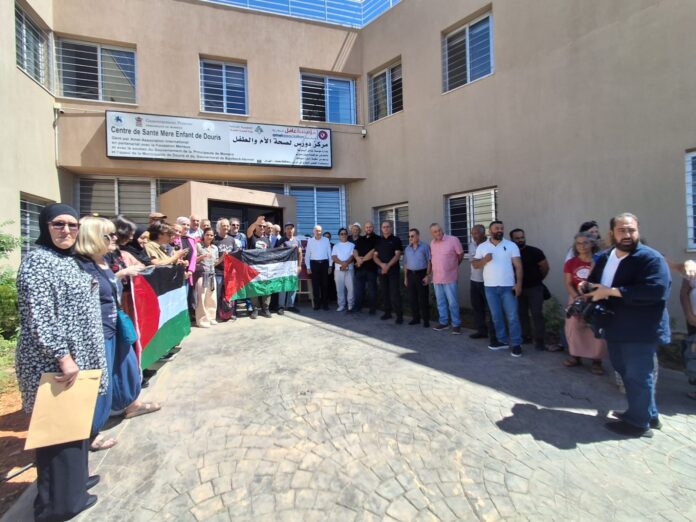
As part of its tour, the delegation visited the Amel Association International Health, Social and Development Centre in Douris–Baalbek, which operates in cooperation with the Municipality of Douris, the Mérieux Foundation, the Ministry of Public Health, and the Baalbek-Hermel Governorate. The delegation was briefed on the centre’s health, social, and development programmes and on Amel’s role in responding to the needs of residents, displaced persons, and the most marginalized groups, particularly amid the exceptional circumstances Lebanon is facing.
The delegation’s itinerary is expected to include several Amel centres and areas of operation, allowing its members to witness firsthand the conditions of local communities, growing humanitarian needs, and the efforts of health, social, and humanitarian teams to support residents and strengthen their resilience.
The delegation was received by Dr. Kamel Mohanna, President of Amel Association International and General Coordinator of the Collective of Voluntary NGOs in Lebanon and the Arab World; Maroun Najm, Mayor of Douris, and his deputy, Chawki Tfaili; Chafic Chehadeh, former president of the Baalbek-Hermel Union of Municipalities; as well as local figures and members of Amel’s Administrative Board. Also participating in the visit were Kassem Aina, coordinator of the activities of the “Let Us Not Forget Sabra and Shatila and the Right of Return” Committee in Lebanon and president of the Association of the Children of Sumoud; journalist and researcher specializing in criminal justice and human rights Dr. Omar Nashabe; and Hajj Nazih Al-Bekaa’i.
Mohanna welcomed the delegation and praised its members’ determination to visit Lebanon at this critical juncture. He stated that “being present in a time of danger speaks louder than a thousand statements of solidarity,” adding that refusing to leave a people alone in the face of war and displacement is, at its core, a defence of shared human values.
Mohanna said: “Your visit today comes as Lebanon is subjected to continuing aggression and as our people in the south endure killing, destruction, and displacement. It affirms that remembrance is not an annual ritual and that the words ‘Let Us Not Forget’ are not merely a slogan about the past, but a responsibility towards the present. We remember Sabra and Shatila not to remain prisoners of tragedy, but to prevent its recurrence and to confront every attempt to normalize the killing of civilians, the destruction of homes, hospitals, and schools, and the displacement of people from their land.”
He added: “From Sabra and Shatila to Gaza and southern Lebanon, the years and places may change, but the moral question remains the same: Where does humanity stand when rights are left defenceless before power? One of the gravest dangers we face today, alongside the aggression itself, is the world becoming accustomed to it—when scenes of death and destruction are reduced to daily news and international law loses its credibility through selective application. Your presence here is therefore a stand against oblivion and indifference, and a message that there are still people in the world who refuse to accept power as a substitute for rights.”
Mohanna stressed that the aggression against Lebanon must be understood within a wider regional context in which the continuation of occupation, armed conflict, and violations against civilians intersects with weak accountability mechanisms. He affirmed that Amel, founded in 1979 amid war and invasions and committed since its establishment to standing beside every human being regardless of identity or affiliation, would maintain its presence and activities in the areas most severely affected. It would not retreat from its health, social, and humanitarian role, regardless of how difficult the circumstances become.
He emphasized that Amel regards humanitarian action as a commitment to justice and human dignity, not merely as a response to the consequences of wars and crises. He said: “It is not enough to tend to the wounds of war victims and then remain silent about the conditions and violations that caused them. Humanitarian action detached from the principles of dignity, justice, and rights risks becoming no more than the management of tragedy. We seek humanitarian action that stands beside people and upholds their rights to life, liberty, and dignity; defends the right of peoples to live safely on their land; and champions rights and the rule of law against the logic of force.”
For his part, Kassem Aina emphasized the importance of continuing such visits at a time when the region is witnessing attempts to erase historical memory and marginalize the Palestinian cause. He stressed that preserving the memory of Sabra and Shatila is not merely about recalling the past, but constitutes a responsibility towards the present and future generations and a continuation of the struggle for justice, the right of return, and the protection of the Palestinian people’s rights.
Journalist and researcher specializing in criminal justice and human rights Dr. Omar Nashabe affirmed that commemorating the Sabra and Shatila massacre cannot be complete without continuing the pursuit of truth, justice, and accountability. He warned that impunity does not consign crimes to the past; rather, it creates the conditions for their recurrence. He said: “What we are witnessing today in Palestine and Lebanon demonstrates that the failure to hold perpetrators accountable for past crimes was not a temporary legal shortcoming, but a factor that contributed to the continuation and expansion of violations. Criminal justice is not an act of revenge; it is a means of protecting communities, preventing the recurrence of crimes, and safeguarding the rights and dignity of victims.”
Hajj Nazih Al-Bekaa’i also welcomed the delegation and commended its members for coming to Lebanon under such difficult circumstances. He affirmed that genuine solidarity is demonstrated when friends choose to draw close to people’s suffering and stand beside them in times of danger. He said: “The delegation’s visit today conveys a clear message to the Lebanese and Palestinian peoples: they are not alone. There are still people in the world who carry their causes in their conscience and refuse to remain silent in the face of the killing, displacement, and destruction inflicted upon them.”
Flavio Novara, Bassam Saleh, and the other members of the delegation expressed their solidarity with the Lebanese and Palestinian peoples. They affirmed that their presence in Lebanon under the current circumstances represents a continuation of the committee’s historic commitment to the victims of Sabra and Shatila and to the Palestinian cause, as well as a message of solidarity with civilians affected by occupation, war, and displacement.
The delegation members also emphasized their responsibility to convey what they witness and hear during their visit to European public opinion, to confront silence and indifference, and to strengthen international solidarity with the rights of the peoples of the region and with civilians who bear the heaviest cost of conflicts and wars.
This year’s visit holds special significance for Amel Association International, which has developed partnerships over several decades with solidarity movements and humanitarian and civil society organizations in Europe and around the world. These partnerships reflect Amel’s vision of building a global solidarity movement that connects the struggles of different peoples and reaffirms the human rights and ethical dimensions of humanitarian action, free from selectivity and double standards.
Amel affirmed that the slogan “Let Us Not Forget” today does not simply mean preserving the names of victims in collective memory; it also means working to prevent new victims. Honoring the victims of Sabra and Shatila, and all victims of wars and massacres, means protecting people before they become statistics, defending their homes before they are reduced to rubble, and safeguarding their rights before they become nothing more than a memory.
Mohanna concluded: “Power may be able to demolish a home, occupy a land, and kill a human being, but it cannot erase a just cause as long as there are people who preserve its memory and defend it. That is why we are here, and why you are here: so that we do not forget, so that silence does not become complicit in crime, and so that rights, the rule of law, and human dignity remain stronger than every attempt to erase them.”

 Creative Commons Attribution 4.0 International license


