


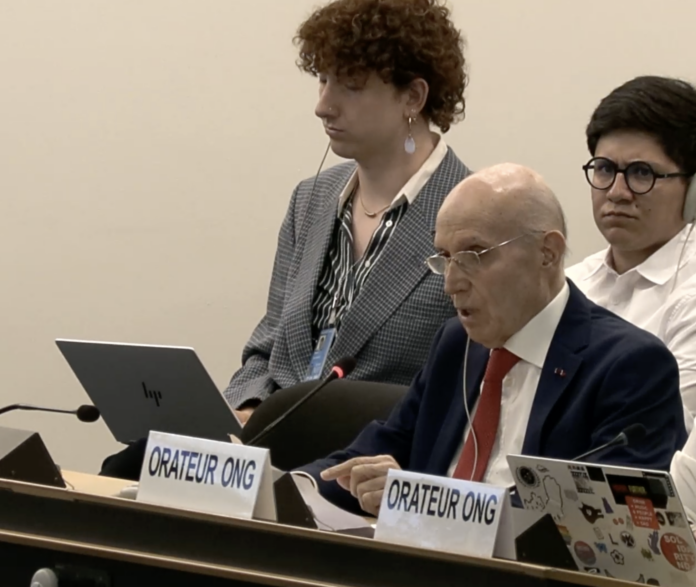
Dr. Kamel Mohanna, President of Amel Association International and General Coordinator of the Arab NGO Network for Development, continues to follow and engage in the discussions taking place during the 62nd Session of the United Nations Human Rights Council in Geneva, as part of his ongoing efforts to advocate for human rights, social justice, and the right to health, while amplifying the voices of communities affected by conflicts, wars, and humanitarian crises.
As part of his participation in the session, Dr. Mohanna addressed the United Nations Human Rights Council today, delivering an oral statement supported by the Centre Europe–Third World (CETIM), in which he highlighted the urgent need to uphold international human rights and humanitarian law, strengthen accountability mechanisms, and ensure the protection of civilians and vulnerable populations affected by armed conflicts and ongoing crises worldwide.
During the session, the United Nations Special Rapporteur on the Right to Health, Dr. Tlaleng Mofokeng, presented her final thematic report entitled “The Right to Health as an Enabler of Human Dignity” (A/HRC/62/66). The report was presented during the sixth meeting of the Human Rights Council and highlighted the fundamental relationship between the right to health and human dignity, emphasizing the need for a human rights-based approach to health policies at both national and international levels.
The report underscores that the right to health extends far beyond access to medical treatment and healthcare services. It constitutes a cornerstone for equality, social justice, and a life of dignity, and any violation of this right directly undermines individuals’ ability to enjoy their broader human rights.
Commenting on the report, Dr. Mohanna stressed that the conflicts and armed crises affecting many regions of the world today, particularly in Lebanon and Palestine, clearly demonstrate the inseparable link between health and human dignity. He emphasized that attacks on hospitals, healthcare facilities, ambulances, and medical personnel represent not only violations of international humanitarian law, but also direct assaults on the rights to life, health, and human dignity.
Dr. Mohanna further noted that health workers and humanitarian actors are increasingly operating under extremely dangerous conditions while civilians face growing barriers to accessing essential healthcare services. He called on the international community to take stronger measures to protect healthcare facilities and personnel and to ensure their safety during armed conflicts.
He also renewed his call for stronger international accountability mechanisms and for systematic documentation of violations committed against civilians and healthcare institutions. Impunity, he warned, weakens the international human rights system and encourages the repetition of violations. He stressed the need for independent and effective investigative mechanisms capable of preserving evidence and ensuring accountability for serious violations of international law.
Dr. Mohanna highlighted that Amel Association International, which has been working in Lebanon and the region since 1979, continues to provide health, social, and humanitarian services to the most vulnerable communities. This commitment stems from the belief that health is a fundamental human right, not a privilege, and that protecting this right is essential for achieving sustainable development, peace, and social justice.
He concluded by emphasizing that the Special Rapporteur’s report comes at a critical international moment, as challenges to the right to health continue to grow across many parts of the world. He called on United Nations Member States to translate their international commitments into concrete policies and actions that guarantee universal access to safe, equitable, and inclusive healthcare services, while protecting civilians, healthcare workers, and medical institutions from the impacts of conflict and violence, thereby safeguarding human dignity and advancing justice and human rights for all.

 Creative Commons Attribution 4.0 International license


