



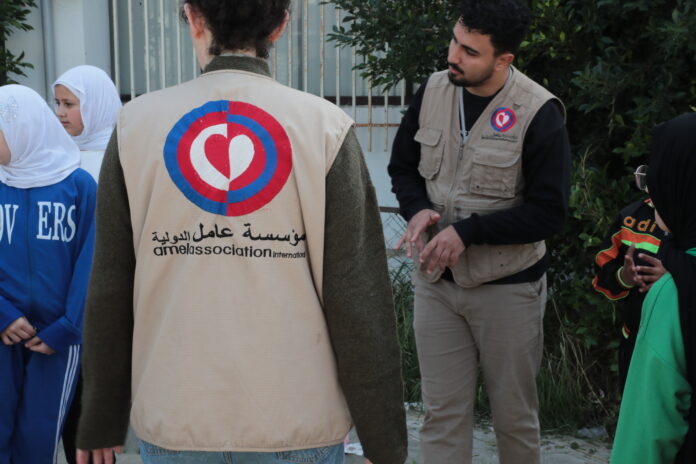
More than two weeks after the escalation of Israeli aggression against Lebanon since 2 March 2026, and amid a sharp and rapidly deteriorating humanitarian situation, Amel Association International has announced the activation of a nationwide emergency response plan to address the growing needs of civilians, particularly displaced populations and the most vulnerable groups. This response is being implemented through its network of 40 centers, alongside its mobile medical units deployed across various regions.
Based on extensive field assessments and daily on-the-ground presence alongside displaced communities, both inside and outside shelters, the organization confirms that Lebanon is facing one of the harshest humanitarian crises in its modern history, in terms of the scale of displacement, the severity of needs, and the fragility of national response systems. Data indicates that nearly one million people have been displaced within a short period, with hundreds of casualties, including more than 110 children, and thousands injured. This is occurring amid serious and repeated violations of international humanitarian law, including the targeting of civilians and protected medical and humanitarian facilities. This reality constitutes a direct threat to fundamental rights, particularly the rights to life, dignity, and security, and poses grave challenges to the humanitarian protection system in Lebanon.
Despite international expressions of solidarity with Lebanon, the organization notes that the level of response remains below the scale of the catastrophe. Needs continue to rise beyond the capacities of national organizations and public institutions, particularly in the context of a deep economic collapse that further constrains response capacities and exacerbates the vulnerability of affected populations.
On the ground, Amel Association continues, in coordination with the Ministry of Public Health and the Disaster Management Unit, to implement multi-sectoral humanitarian interventions. Teams are working around the clock to ensure equitable and dignified access to essential services, guided by a rights-based, non-discriminatory approach. In this context, the organization has launched a global appeal to mobilize resources and strengthen international solidarity, recognizing that the scale of needs exceeds the capacity of any single actor.
In the health sector, the organization has activated an integrated network of mobile clinics and primary healthcare centers. Medical teams are deployed to shelters and informal settlements, providing services including medical consultations, distribution of medications, reproductive health services, vaccination campaigns, and follow-up care for chronic conditions. In parallel, Amel continues to operate 12 health centers and dispensaries across Lebanon, adapting operational modalities in response to evolving security conditions to ensure continuity of care, particularly in the most affected and hard-to-reach areas.
In the area of protection and psychosocial support, the organization provides psychological first aid, case management, and referrals for more complex cases to specialized services, with a particular focus on women and children exposed to heightened risks in displacement settings. It has also launched recreational and protective activities within shelters, benefiting 2,617 children to date, with the aim of mitigating trauma and fostering a sense of safety and stability in overcrowded and high-stress environments.
With regard to older persons, the organization has given special attention to this group, which faces compounded challenges including limited mobility, difficulty accessing services, and increased isolation. A total of 259 displaced elderly individuals have been reached through emergency home visits and integrated services, including medical and nursing care, psychosocial support, and the distribution of essential items. Field data indicates significant gaps in meeting the needs of this group, underscoring the need to scale up targeted interventions.
In the field of food security and basic assistance, the organization has distributed thousands of food parcels and hygiene kits to displaced families and host communities, and is working to expand distribution efforts across different regions to respond to growing needs and ensure a minimum standard of dignified living conditions.
In parallel with its humanitarian response, Amel Association is working to strengthen social cohesion in the face of rising hate speech and divisions, drawing on its longstanding experience in managing recurrent crises in Lebanon. This is being carried out in partnership with local organizations, municipalities, and international partners, with the aim of protecting the social fabric and preventing its fragmentation under these critical circumstances.
Despite these efforts, the humanitarian response continues to face significant challenges, including limited resources, ongoing displacement, restricted access to certain areas, and the presence of large numbers of displaced individuals outside formal shelters, which complicates assessment and response efforts. Field teams are also under increasing pressure due to the surge in demand for services, the complexity of referral and coordination mechanisms, and the displacement of some staff members themselves.
In this context, Amel Association International emphasizes that Lebanon is facing a protracted humanitarian crisis that requires urgent and sustained action beyond short-term, conventional responses. It calls on the international community, donors, and all relevant stakeholders to assume their responsibilities and support humanitarian efforts in Lebanon, ensuring the delivery of life-saving assistance, the strengthening of protection mechanisms, and the preservation of human dignity.
For over four decades, Amel Association International has remained committed to serving the most vulnerable communities in Lebanon. Today, it renews this commitment through a comprehensive humanitarian response grounded in justice, solidarity, and non-discrimination, in the face of one of the most severe crises the country has experienced.
Ways to Contribute and Support
Amel Association International invites individuals and partners to support the emergency humanitarian response in Lebanon through the following channels:
📍 From Europe:
PayPal
https://www.paypal.com/donate?campaign_id=Q5EFZUHA6RVG8
📍 From the United States:
GoFundMe
https://www.gofundme.com/f/emergency-fund-for-lebanon
📍 From France:
HelloAsso
https://www.helloasso.com/associations/humacoop-amel-france/formulaires/17
📍 From Lebanon:
Whish Money
📞 +961 81 163 315
📧 For in-kind donations:
fundraising@amel.org
📧 For partnerships and collaboration:
zeinamohanna@amel.org

 Creative Commons Attribution 4.0 International license


