



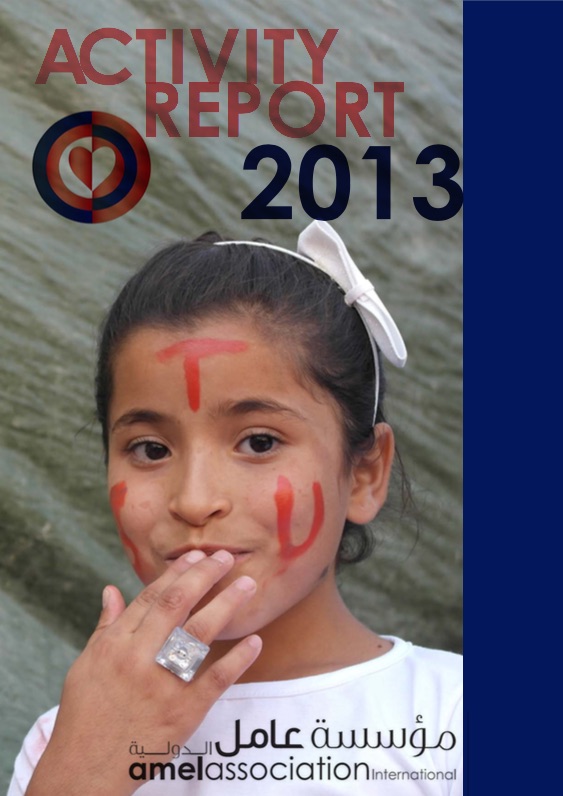
Amel Association International: Annual Activity Report 2013
35 Years of Humanitarian Action, Human Rights and Community Development
The 2013 Annual Activity Report marked a significant milestone for Amel Association International as the organization celebrated 35 years of humanitarian service in Lebanon. Against the backdrop of the rapidly escalating Syrian refugee crisis, Amel expanded its emergency response while reinforcing its long-term commitment to health, education, livelihoods, women’s empowerment and human rights.
Guided by its enduring motto—“Positive Thinking and Permanent Optimism”—and its philosophy that Principles define a Position that is put into Practice, Amel demonstrated how locally led humanitarian action can combine emergency relief with sustainable development.
A Legacy of Non-Sectarian Humanitarian Action
Founded in 1979 during the Lebanese Civil War, Amel has consistently provided assistance based solely on human need, regardless of nationality, religion or political affiliation.
By 2013, the organization operated:
- 24 community centres across Lebanon
- 4 Mobile Medical Units (with further expansion planned)
- Programmes spanning health, education, livelihoods, gender equality, rural development, migrant workers’ rights and human rights
During the year, Amel delivered more than 350,000 humanitarian and development services, reinforcing its role as one of Lebanon’s leading civil society organizations.
Responding to the Syrian Refugee Crisis
As the conflict in Syria intensified, Lebanon became the country hosting the highest number of refugees per capita in the world.
The report highlights that:
- Nearly one million Syrian refugees were registered in Lebanon by 2013.
- The World Bank estimated the economic cost of the crisis to Lebanon at US$7.5 billion.
- Approximately 320,000 Lebanese jobs were expected to be lost.
- Around 250,000 Syrian refugee children remained out of school.
- Public services—including schools, hospitals, electricity and water systems—were under unprecedented strain.
In response, Amel mobilized its nationwide network to deliver comprehensive emergency assistance through healthcare, education, child protection, livelihoods, social cohesion and relief distributions.
The report emphasizes that humanitarian action must support both refugees and vulnerable Lebanese host communities while strengthening social cohesion and resilience.
Expanding Healthcare Across Lebanon
Healthcare remained the cornerstone of Amel’s mission.
To respond to growing needs, the organization expanded primary, secondary and mental healthcare services through its centres and mobile clinics.
Services included:
- General medical consultations
- Paediatric care
- Gynaecology
- Dental care
- Physiotherapy
- Laboratory testing
- Medicines
- Mental health services
- Family planning
- Vaccination campaigns
- Hygiene promotion
2013 Health Highlights
- 89,460 primary healthcare consultations
- 14,732 consultations delivered through Mobile Medical Units
- 1,100 beneficiaries supported through Secondary Healthcare programmes
- More than 30,000 consultations provided to children under five years of age
The organization also expanded mental health services for refugees and vulnerable communities experiencing trauma caused by conflict, displacement and loss.
Education and Child Protection
Recognizing education as one of the strongest forms of protection for children affected by conflict, Amel significantly expanded its educational programmes.
Working with UNHCR, UNICEF, Save the Children, the Lebanese Ministry of Education and other partners, the organization implemented:
- Remedial education
- Accelerated Learning Programmes (ALP)
- Back-to-School campaigns
- Child-friendly spaces
- Psychosocial support
- Recreational activities
- Home visits and counselling
- Parenting support
Programme Results
- 7,468 children enrolled in public schools through the Back-to-School campaign.
- 2,777 children enrolled in second-shift public schools.
- 4,602 children attended Accelerated Learning Programmes.
- Child protection programmes expanded to additional community centres with UNICEF support.
Creative approaches—including theatre, storytelling, drawing, games and art therapy—helped children recover from the psychological effects of war and displacement while rebuilding confidence and resilience.
Livelihoods and Youth Empowerment
As economic pressures mounted across Lebanon, Amel continued investing in livelihood programmes that promoted dignity, self-reliance and social cohesion.
Training opportunities included:
- English language
- Computer skills
- Graphic design
- Hairdressing
- Nursing
- Computer maintenance
- Mobile phone repair
- Handicrafts
- Life-skills development
- Conflict resolution
Participants also benefited from internships, apprenticeships and links with potential employers.
During 2013:
- More than 200 women and young people benefited from income-generating activities.
- 450 youth completed technical and vocational training.
One flagship initiative remained Mann Hiya, a cooperative producing handmade accessories created by refugee and Lebanese women from Syria, Iraq, Sudan, Ethiopia and Lebanon, transforming traditional craftsmanship into sustainable income opportunities.
Advancing Human Rights
The Amel House of Human Rights (AHHR) continued strengthening legal education and human rights awareness throughout Lebanon and the Arab region.
Its work focused on:
- Refugee Law
- International Humanitarian Law
- International Criminal Law
- Peacebuilding
- Citizenship
- Democracy
- Civil rights
Among its flagship initiatives were:
- Video Advocacy Action (VAA), enabling young people to produce short films on issues such as child labour, discrimination and violence against women.
- The Summer School on Law and Armed Conflict, bringing together participants from Lebanon and across the Arab region.
- Legal research, workshops and public debates addressing international humanitarian law and prisoners’ rights.
These initiatives reinforced AHHR’s role as a regional hub for human rights education, legal training and advocacy.
Protecting Migrant Domestic Workers
The report highlights Amel’s leadership in promoting the rights of Migrant Domestic Workers (MDWs), one of Lebanon’s most vulnerable populations.
During 2013, the programme combined:
- Legal assistance
- Psychological support
- Health services
- Capacity-building
- English and computer classes
- Awareness campaigns
- Advocacy for legal reform
A major milestone was Amel’s leadership in drafting a proposed national law to protect Migrant Domestic Workers, developed in collaboration with Lebanese ministries, the International Labour Organization (ILO), the Office of the United Nations High Commissioner for Human Rights (OHCHR), civil society organizations and recruitment agencies.
The programme also:
- Assisted more than 200 MDWs through social support services.
- Provided 106 legal consultations.
- Delivered psychological support to 105 survivors of violence and exploitation.
- Raised awareness among 2,019 Lebanese citizens and 465 Migrant Domestic Workers on labour rights, human trafficking and protection.
Women’s Empowerment and Rural Development
Women’s economic empowerment remained central to Amel’s long-term development strategy.
Working with UN Women, the organization implemented programmes supporting rural and refugee women through:
- Business management training
- Marketing skills
- Economic rights awareness
- Food processing
- Organic production
- Handicrafts
- Rural entrepreneurship
The Ebl El Saqi Cooperative continued producing natural soaps, medicinal herbs and essential oils while creating sustainable income opportunities for women in South Lebanon.
During 2013:
- 289 rural women and 215 refugee women participated in economic rights and awareness sessions.
- Women from Lebanon, Syria, Iraq, Sudan and Egypt received specialised managerial and marketing training to strengthen their access to local markets.
Building a Fairer Future Through Local Humanitarian Leadership
The 2013 Activity Report captures a defining moment in Amel’s history: celebrating 35 years of humanitarian action while responding to one of the largest displacement crises in the Middle East.
Beyond delivering emergency assistance, the report advocates for a humanitarian model rooted in solidarity, partnership and local leadership. It argues that sustainable responses require investment not only in immediate relief but also in education, livelihoods, human rights and community resilience.
As the report concludes, Amel’s work is driven by a simple but enduring belief: positive thinking, principled action and lasting partnerships can help build a more just, inclusive and resilient future for everyone.

 Creative Commons Attribution 4.0 International license

