



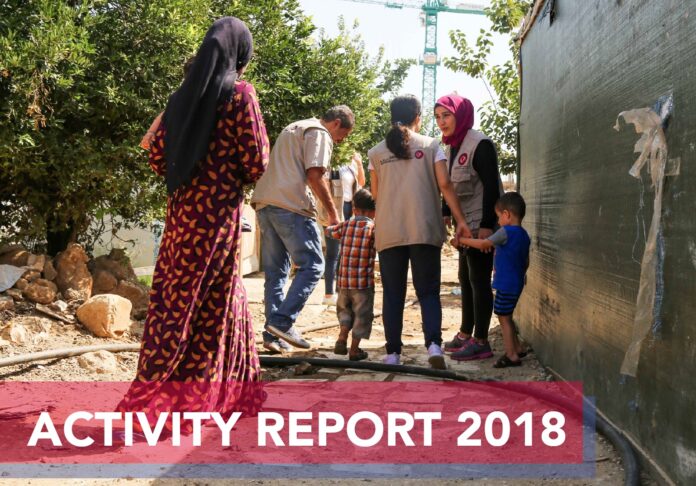
Advancing dignity, solidarity and access to fundamental rights across Lebanon
In 2018, Amel Association International continued its mission to support vulnerable communities across Lebanon through integrated health, education, protection, livelihood, food security and human rights programmes.
Established in 1979 by Dr. Kamel Mohanna, Amel is an independent, non-governmental and non-sectarian organization committed to serving people without discrimination based on nationality, ethnicity, gender, age, political opinion or religious affiliation.
Through a nationwide network of 24 community centres, six Mobile Medical Units, two Mobile Education Units and one Mobile Protection Unit, Amel delivered essential services in Beirut and Mount Lebanon, the Bekaa and South Lebanon, including in remote and hard-to-reach communities.
Healthcare at the heart of Amel’s mission
Healthcare remained one of Amel’s central priorities. In 2018, the organization operated through six primary healthcare centres and seven dispensaries, offering affordable and inclusive medical services to vulnerable Lebanese and refugee communities.
Services included general medical consultations, paediatrics, gynaecology, family planning, vaccination, laboratory testing, medical imaging, chronic disease management and psychological support.
Amel’s six Mobile Medical Units also travelled to informal settlements, shelters and remote municipalities in the Bekaa and South Lebanon. They provided basic healthcare, health and hygiene awareness, disease prevention and social counselling, reaching more than 68,000 beneficiaries during the year.
Supporting children’s education and protection
Amel considers education a fundamental right and a critical pathway toward protection, inclusion and social development.
During 2018, more than 1,350 vulnerable children participated in homework support, remedial education, reading, recreational and psychosocial activities at Amel centres in Haret Hreik and Ain El Remaneh.
Child protection programmes, including psychosocial support for children, parenting-skills sessions and awareness activities for adults, reached more than 16,000 beneficiaries.
Education on the move
Amel’s Mobile Education Units—widely known as the “Amel Bus”—brought educational, cultural and psychosocial services directly to children living in informal settlements.
Equipped with books, educational games, digital tablets, projection equipment and a private space for psychological consultations, the mobile units supported approximately:
- 800 children in informal settlements in the Khiam–Marjayoun area;
- 600 children in Kamed El Loz and West Bekaa.
Activities included remedial education, homework assistance, individual consultations, children’s focus groups, theatre, drawing, outdoor activities and weekly film screenings.
Protecting children and young people in street situations
Amel’s Mobile Protection Unit operated in marginalized areas of Beirut and its suburbs, reaching children and young people living, begging or working on the streets.
Composed of a social worker, a nurse and a driver-social assistant, the unit provided medical and social assistance, referrals and accompaniment to Amel centres and partner organizations.
The Mobile Protection Unit reached 530 beneficiaries in 2018, helping children access protection, education and appropriate support services.
Empowering young people
Amel’s livelihood and youth programmes sought to strengthen the skills, confidence and economic opportunities of Lebanese and refugee youth.
More than 7,000 young people benefited from vocational training, language classes, information technology courses, internships, life-skills training, coaching and psychosocial support.
Youth empowerment and volunteering initiatives also encouraged young people to assume leadership roles, promote equality and non-discrimination, confront hate speech and participate in peacebuilding and community action.
Women’s empowerment and rural development
Women’s economic and social empowerment remained an essential component of Amel’s work.
Through vocational training, awareness activities and community-based initiatives, Amel supported women in rural and urban communities to develop their skills and increase their economic independence.
Projects included:
- Mann Hiya, supporting women producing handmade crafts;
- the Ebl El Saqi artisanal soap factory;
- Menna Hand Made Products, promoting women-led food production, recycling, handicrafts, accessories and organic soap;
- the Menna Catering Group, created by women preparing sweet and savoury products for events.
Alongside these initiatives, Amel continued advocating for women’s rights and greater equality regardless of nationality, background or religious belief.
Supporting migrant domestic workers
Amel adopted a comprehensive approach to supporting migrant domestic workers and victims of human trafficking.
Its programmes combined legal, health, social and psychosocial services with advocacy, research, awareness raising, skills development and cooperation with countries of origin.
Activities included legal case management, healthcare consultations, language and computer classes, professional training and awareness programmes addressing the rights and responsibilities of workers and employers.
Amel also developed training tools to help identify victims of human trafficking and improve understanding of labour rights and responsibilities.
Care and inclusion for older persons
Amel supported vulnerable older people through medical consultations, chronic disease awareness, occupational therapy, gardening, cooking and intergenerational activities.
Amel centres were also adapted to improve accessibility and respond more effectively to the needs of older persons.
These programmes reached approximately 2,700 beneficiaries in 2018.
Food security and community resilience
Amel’s food security activities responded to the increasing economic vulnerability of refugee and host communities.
Collective kitchens and community gardens were established in several areas, including Ain El Remaneh, Haret Hreik and Khiam. Participants received training in nutrition, healthy low-cost cooking and agricultural production.
During the year:
- 21,800 meals were distributed to vulnerable people;
- fruits and vegetables grown in community gardens were shared with families;
- 75 micro-gardens were established in West Bekaa;
- 55 women and 20 men received agricultural training;
- a community event brought together approximately 380 participants.
These initiatives helped families improve food access while developing practical skills and strengthening community solidarity.
Promoting human rights education
The Amel House of Human Rights, developed in cooperation with La Sagesse University, continued to promote advanced education and training on human rights and international humanitarian law.
Its annual summer school on the law applicable during armed conflict brought together around 50 participants from across the Arab region, contributing to the development of a new generation of human rights practitioners and advocates.
A growing international presence
In 2018, Amel strengthened its international engagement through its consultative status with the United Nations Economic and Social Council and observer status with the International Organization for Migration.
The organization also participated in several international humanitarian and civil-society networks and expanded its presence through offices in France, Switzerland and the United States.
Through the **“3Ls” initiative—Lebanon, Lampedusa and Lesbos—**Amel worked with international partners to promote cooperation, exchange experience and defend the rights and dignity of refugees and people in exile.
A commitment that continues
Amel’s 2018 activities reflected a consistent commitment to placing human dignity at the centre of humanitarian and development action.
By combining immediate assistance with education, empowerment, protection and human rights advocacy, Amel continued working toward a fairer and more inclusive society in which every individual can access fundamental rights and participate fully in public life.
“Nobody is able to choose their place of birth or their family. No one is given the choice to grow up in a war-torn country.”
— Dr. Kamel Mohanna, President of Amel Association International

 Creative Commons Attribution 4.0 International license

