



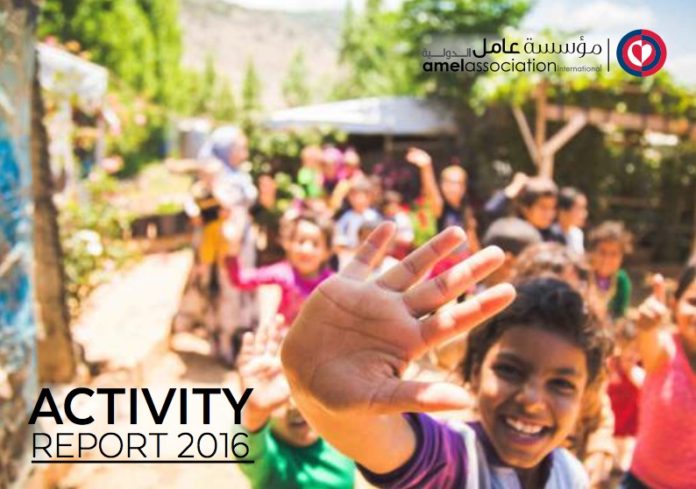
Expanding Access to Health, Education and Human Rights Across Lebanon
In 2016, Amel Association International continued its mission of supporting vulnerable and underserved communities across Lebanon through inclusive, rights-based humanitarian and development programmes.
Founded in 1979 by Dr. Kamel Mohanna, Amel is a non-governmental, civil and non-sectarian organisation. Through a network of 24 centres, six Mobile Medical Units and a Mobile Education Unit, the organisation delivered healthcare, education, protection and development services without discrimination based on nationality, religion or political affiliation.
By the end of 2016, Amel had provided more than eight million accessible health and psychosocial services since its establishment.
Health and Medical Support
Healthcare remained at the heart of Amel’s work in 2016.
Through 15 primary healthcare centres located across Lebanon, patients were able to access:
- General and specialised medical consultations
- Family-planning services
- Medication and laboratory testing
- Vaccinations and X-rays
- Health-awareness activities
- Referrals to specialised services
Several Amel centres were integrated into the Lebanese Ministry of Public Health network, contributing to improved quality of care and stronger coordination within the national healthcare system.
During 2016, Amel’s primary healthcare centres provided approximately 250,000 medical consultations.
Mobile Medical Units Reaching Remote Communities
Amel operated six Mobile Medical Units in informal settlements, shelters and remote municipalities in the Bekaa and South Lebanon.
The mobile teams delivered basic healthcare, health education and social counselling while supporting efforts to monitor and prevent communicable diseases.
More than 50,000 beneficiaries were reached through the Mobile Medical Units during the year.
Education and Child Protection
Amel considers access to education a fundamental right for every child.
In 2016, more than 1,000 vulnerable children benefited from educational, recreational and psychosocial activities through Amel’s centres in Haret Hreik and Ain El Remmaneh, as well as through the Mobile Education Unit operating in the Marjayoun area.
Activities included:
- Homework and remedial support
- Reading sessions
- Recreational and cultural activities
- Individual psychosocial consultations
- Awareness sessions for parents
- Parenting-skills support
These programmes assisted children from refugee and host communities in remaining engaged with formal education while strengthening their emotional and psychosocial well-being.
The Amel Mobile Education Unit
In 2016, Amel launched a pilot Mobile Education Unit following a needs assessment in the Khiam–Marjayoun area.
Known as the Amel Bus, the vehicle was equipped with books, educational games, digital tablets, seating, projection equipment and a private space for psychological consultations.
Operating weekly in five informal settlements, the unit provided children and parents with educational support, psychosocial services, cultural activities and recreational opportunities.
Livelihood and Youth Development
Amel’s livelihood programmes sought to equip young people with the skills and opportunities needed to participate actively in society.
More than 7,000 young people benefited in 2016 from activities including:
- Vocational training
- Language courses
- Information technology training
- Internships
- Life-skills development
- Psychosocial support
The programmes targeted both Lebanese and refugee youth, helping them strengthen their employability, resilience and social participation.
Gender Equality and Rural Development
Women’s economic and social empowerment remained a central priority.
Amel supported women in rural and urban communities through initiatives focused on handicrafts, food production, recycling, handmade accessories and organic soap.
Projects included the Mann Hiya handmade crafts initiative, the artisanal soap factory in Ebl El Saqi and the Menna project, which connected women producers with markets and wider sales opportunities.
The Menna Handmade Products shop served as a showroom and marketplace, while the Menna Catering Group enabled women to prepare and sell sweet and savoury products for events and special occasions.
Amel also participated in national campaigns advocating for women’s rights.
Youth Empowerment and Volunteering
In 2016, Amel hosted Lebanon’s first Erasmus+ workshop, bringing together 30 participants from 10 countries to exchange experiences and develop approaches to countering hate speech.
Amel also continued involving young people in international and local initiatives addressing:
- Leadership
- Communication
- Peacebuilding
- Equality and non-discrimination
- Migrant inclusion
- Entrepreneurship
- Community volunteering
Local volunteers contributed to educational and environmental activities, including teaching support and tree-planting initiatives in Beirut.
Supporting Migrant Domestic Workers
Amel continued implementing its programme for migrant domestic workers and victims of human trafficking through a comprehensive approach combining:
- Advocacy
- Rights-awareness activities
- Skills development
- Research
- Case management and referrals
- Legal, medical, social and psychosocial assistance
During 2016, Amel strengthened cooperation with organisations in countries of origin, including Bangladesh, Ethiopia, Nepal and Sri Lanka.
The programme sought to improve the living and working conditions of migrant domestic workers and to provide protection and assistance to survivors of exploitation, abuse and trafficking.
Amel House of Human Rights
The Amel House of Human Rights, established in cooperation with La Sagesse University, continued developing education and training programmes on human rights and international humanitarian law.
Its annual Summer School on the Law of Armed Conflict brought together approximately 50 participants from across the Arab region.
The initiative aimed to serve as an academic and training reference for human rights and humanitarian law in Lebanon and the wider Arab world.
Strengthening Amel’s International Presence
In 2016, Amel continued expanding its international engagement through its membership in the United Nations Economic and Social Council and international humanitarian networks.
The organisation established offices in France and Switzerland to share and adapt its experience of supporting vulnerable populations.
Amel also participated in discussions connected to the World Humanitarian Summit and the international debate on reshaping humanitarian action.
The organisation’s work was recognised through the annual prize of the Fondation Ghazal pour l’éducation, la recherche et la paix au Liban.
Nobel Peace Prize Nomination
Amel Association International was nominated for the 2016 Nobel Peace Prize by former Lebanese Minister of Finance and university professor Georges Corm.
The nomination recognised Amel’s commitment to social justice and its support for marginalised Lebanese communities, Palestinian and Syrian refugees, migrant workers and other vulnerable populations.
Since April 2012, Amel had provided more than 1.8 million services to people affected by the Syrian crisis in Lebanon, contributing to one of the most significant civil-society responses to the regional emergency.
“Nobody is able to choose their place of birth or their family. No one is given the choice to grow up in a war-torn country.”
— Dr. Kamel Mohanna, President of Amel Association International
A Commitment to Dignity and Solidarity
Amel’s work in 2016 reflected its long-standing commitment to dignity, solidarity and equal access to rights.
By combining emergency assistance with long-term development, education, empowerment and human-rights programmes, Amel continued building a model of humanitarian action rooted in social justice, coexistence and respect for every person.

 Creative Commons Attribution 4.0 International license

