



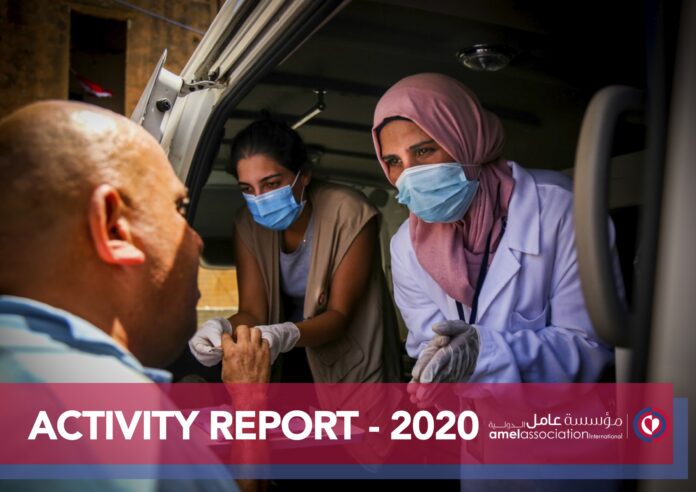
Responding with resilience during Lebanon’s most challenging year
The year 2020 marked one of the most difficult periods in Lebanon’s modern history. The COVID-19 pandemic, an unprecedented economic collapse and the devastating Beirut Port explosion created a humanitarian emergency that affected millions.
Throughout these overlapping crises, Amel Association International remained on the front lines, expanding its humanitarian response while continuing to provide healthcare, protection, education and human rights services across Lebanon.
Building on more than four decades of community engagement, Amel strengthened its nationwide presence through 28 community centres, six Mobile Medical Units, two Mobile Education Units and one Mobile Protection Unit, ensuring that vulnerable Lebanese communities, refugees and migrants continued to access lifesaving services despite extraordinary challenges.
Leading Lebanon’s COVID-19 Response
When the COVID-19 pandemic reached Lebanon, Amel rapidly transformed its healthcare operations into a nationwide emergency response.
Its multidisciplinary intervention included:
- Infection prevention and control training
- Provision of personal protective equipment (PPE)
- Support to the Ministry of Public Health’s contact tracing system
- Establishment of isolation rooms
- Symptom screening
- Home-based medical follow-up
- Launch of the Ministry’s national COVID-19 hotline with 45 registered nurses
- Deployment of Rapid Response Teams
Amel also became the first organization to conduct PCR testing inside informal refugee settlements, beginning in Ersal in partnership with Fondation Mérieux, Université Saint Joseph and the Ministry of Public Health.
During the early stages of the pandemic, Amel and its partners conducted more than 5,200 PCR tests among vulnerable refugee communities.
Primary Healthcare
Despite multiple national crises, Amel continued providing essential healthcare services throughout Lebanon.
Operating through 14 medical centres and 6 Mobile Medical Units, the organization delivered:
- 240,000 healthcare services and consultations
- Launch of 2 new medical centres
- Training of 3 Rapid Response Teams
This extensive network ensured uninterrupted access to healthcare for Lebanese communities, refugees and migrants throughout the pandemic.
Mental Health
Recognizing the growing psychological impact of the pandemic, economic hardship and the Beirut explosion, Amel significantly expanded its mental health programme.
Psychological and social support became fully integrated across community centres, medical facilities and education programmes.
Highlights included:
- 1,000 mental health consultations in Ersal
- 900 consultations in Kamed El Loz
- Permanent psychologists and social workers across Amel’s centres
- Community awareness campaigns to reduce stigma surrounding mental health
The programme was implemented in partnership with the German Federal Foreign Office, Medico and Médecins du Monde.
Beirut Blast Emergency Response
Following the catastrophic explosion on 4 August 2020, Amel mobilized one of Lebanon’s largest civil society emergency responses.
The organization deployed:
- 800 staff members
- 6 Mobile Medical Clinics
- 25 community centres
- Mobile Protection Units
- Psychosocial Support Teams
- Food Security Teams
Emergency interventions included:
- Medical consultations
- Wound treatment
- Distribution of medicines
- Food parcels and hot meals
- Hygiene kits
- Psychosocial support for children
- Nationwide donation campaigns
- International solidarity appeals
Amel’s rapid response highlighted the organization’s capacity to respond simultaneously to humanitarian emergencies while maintaining ongoing services nationwide.
Food Security & Emergency Relief
As Lebanon’s economic crisis deepened, food insecurity became one of the country’s most urgent humanitarian challenges.
Amel responded by:
- Distributing food parcels
- Providing hot meals
- Supporting families affected by the Beirut explosion
- Expanding sustainable agriculture initiatives
- Training women in food production and vocational skills
Working alongside Buzuruna Juzuruna, the programme also promoted self-sufficiency by encouraging small-scale agriculture and income generation.
Supporting Migrant Workers & Victims of Human Trafficking
Throughout 2020, Amel strengthened one of Lebanon’s leading protection programmes for migrant workers.
Beyond migrant domestic workers, the programme expanded to support all vulnerable migrant workers whose situation deteriorated because of COVID-19 and the economic crisis.
Services included:
- Legal assistance
- Health services
- Social support
- Advocacy
- Repatriation assistance
- Research
- Group therapy
- Awareness campaigns
Additional emergency assistance included:
- 400 food parcels
- 200 hygiene kits
- 120 emergency rent grants
- 40 voluntary return tickets
- Support for 600 at-risk migrants
- Tailored legal support for 150 vulnerable migrants
Following the Beirut explosion, additional hygiene kits, mattresses and emergency supplies were distributed to affected migrant communities.
Education During Lockdown
When schools closed due to COVID-19, Amel rapidly redesigned its education programme.
Innovative remote learning approaches enabled educational continuity through:
- Distance learning
- Recreational activities
- Psychosocial support
- Home-based learning materials
- Creative educational methods
More than 1,680 children and young people continued receiving education and psychosocial support throughout the year.
Mobile Education Unit
Amel’s Mobile Education Units adapted to lockdown restrictions by introducing a redesigned educational curriculum suitable for remote and community-based learning.
The programme continued delivering:
- Educational support
- Recreational activities
- Psychosocial services
- Awareness campaigns
The Mobile Education Units reached:
- 600 Syrian children in Bekaa
- 600 Syrian children in South Lebanon
ensuring that education remained accessible despite mobility restrictions.
Child Protection
Child protection remained a core priority throughout the pandemic.
Programmes focused on:
- Community child protection committees
- Parenting skills
- Safe spaces
- Psychosocial support
- Municipal coordination
- Community engagement
In 2020, these initiatives benefited 17,613 children and caregivers across Lebanon.
Mobile Protection Unit
Amel’s Mobile Protection Unit continued reaching vulnerable children living in highly marginalized conditions.
Operating according to Samusocial International standards, two specialized teams worked day and night to provide:
- Social support
- Healthcare
- Psychological referrals
- Life-skills sessions
- In-kind assistance
The programme supported 450 beneficiaries during 2020.
Women’s Empowerment
Despite movement restrictions, Amel continued empowering women through innovative remote learning and entrepreneurship programmes.
Achievements included:
- Supporting 55 Lebanese and refugee women in launching small businesses
- Training 760 women in leadership, vocational and psychosocial programmes
- Expanding remote learning platforms
- Promoting women’s economic independence
The MENNA Shop continued creating market opportunities for handmade products while hundreds of women received online training in handicrafts, knitting, accessories and mask production.
Sexual & Reproductive Health and Gender-Based Violence
Amel continued protecting women and girls by adapting services to pandemic conditions.
Key achievements included:
- 25,000 people reached through online awareness campaigns
- 2,600 Sexual and Reproductive Health consultations
- 24,780 outreach services
- 2,100 adolescents reached through awareness and life-skills activities
These interventions ensured uninterrupted access to essential health and protection services during lockdown.
Youth Empowerment & Leadership
Young people remained central to Amel’s community development strategy.
Although activities moved online, 360 young people participated in programmes promoting:
- Leadership
- Communication
- Dialogue
- Volunteering
- Community engagement
- Online awareness campaigns
The Amel Sports League also adapted its activities to prioritize children’s mental wellbeing through remote engagement.
Protecting Older Persons
Older persons were among the groups most affected by both COVID-19 and the Beirut explosion.
Amel provided:
- Home medical visits
- Nursing care
- Mental health referrals
- Hygiene kits
- Essential relief items
The programme targeted 700 older persons, with 500 receiving home-based healthcare.
Human Rights Education
The Amel House of Human Rights continued advancing education on human rights and International Humanitarian Law.
In collaboration with La Sagesse University, AHHR organized:
- Annual Summer School on the Law of Armed Conflict
- Human Rights training
- Video Advocacy Action Training
- Courses on Palestinian rights
Despite global restrictions, AHHR maintained its role as a regional centre for human rights education.
2020 by the Numbers
| Impact | Results |
|---|---|
| Community Centres | 28 |
| Primary Healthcare Centres | 14 |
| Mobile Medical Units | 6 |
| Mobile Education Units | 2 |
| Mobile Protection Unit | 1 |
| Health consultations & services | 240,000 |
| PCR tests conducted | 5,200+ |
| Mental health consultations | 1,900 |
| Children in education programmes | 1,680+ |
| Child protection beneficiaries | 17,613 |
| Mobile Education beneficiaries | 1,200 |
| Mobile Protection beneficiaries | 450 |
| Women trained | 760 |
| Women launching businesses | 55 |
| SRH consultations | 2,600 |
| Online awareness participants | 25,000 |
| Medical consultations under social cohesion | 5,589 |
Standing with Lebanon Through Crisis
The challenges of 2020 tested every humanitarian organization operating in Lebanon. Yet throughout the COVID-19 pandemic, the Beirut Port explosion and the country’s worsening economic crisis, Amel Association International continued to expand—not reduce—its humanitarian response.
By combining emergency healthcare, protection, food security, education, mental health services and human rights advocacy, Amel demonstrated that local humanitarian leadership remains essential in times of national crisis, ensuring that dignity, solidarity and hope continue to reach those who need them most.

 Creative Commons Attribution 4.0 International license

